


Interview with AJC Hawks beat reporter Lauren Williams
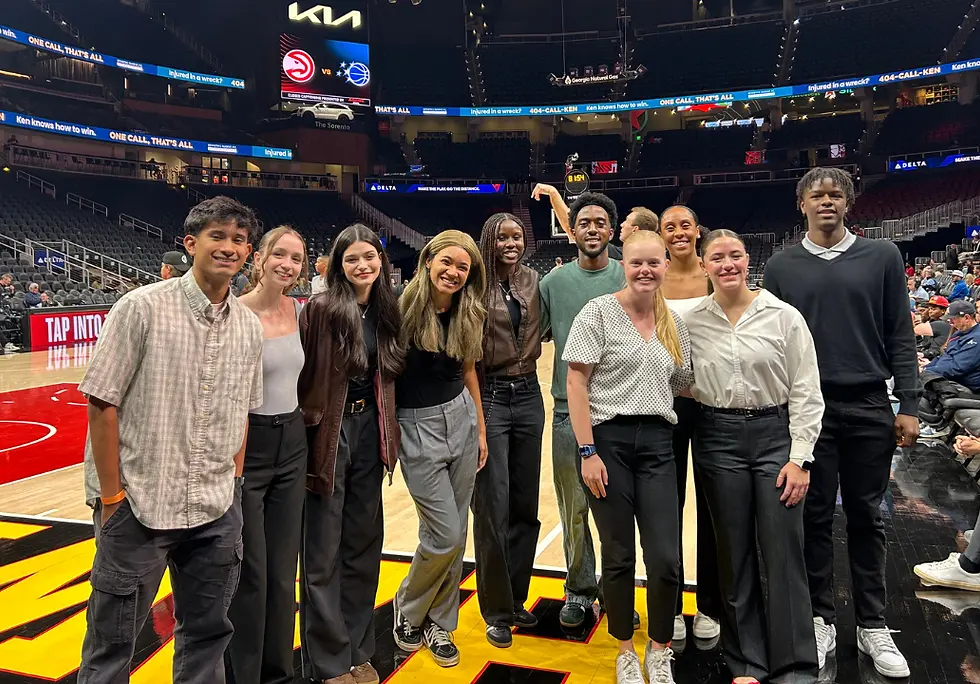
Ten Oglethorpe students attended an Atlanta Hawks game on Nov. 4, 2025. Sitting courtside, they got an inside look at the behind-the-scenes happenings: the players warming up, the photographers adjusting their cameras, and the operations team completing their game-day responsibilities.
Their visit to the State Farm Arena was part of a program created by Communications Studies Program Coordinator Kate Keib. The program was created to give students hands-on experience in sports communication. Students created projects such as graphics, photography, social media campaigns, and written articles.
The Stormy Petrel co-editor Isabella Fonseca interviewed AJC Hawks beat reporter Lauren Williams and learned about sports journalism from an industry professional. The video call lasted forty minutes, and the conversation ranged from Williams’ own career to her advice for aspiring journalists to how to tell empathetic stories in an often unempathetic climate.
The full transcript is available here.
[This interview has been edited for brevity and clarity]
***
On her career and breaking into the industry
Fonseca: I read in the introduction article about you in the AJC that you fell in love with journalism at the age of 13. Could you tell me a little bit about how you discovered this passion?

Williams: Yeah, so back in the early 2000s or late 2000s, Soledad O’Brien worked for CNN, and she had a series called “Black in America.” It just spoke to me because it was such a deep dive into systemic problems in the African American community and how it impacted their ability to move forward.
Now, I can’t remember all of the specific stories that she told because that was almost 20 years ago, but it resonated with me because it was just such a deep dive. There was so much research she did. She went into the history of African Americans in the US, going through slavery, Jim Crow, and the Civil Rights Movement. And the level of detail that she went to in order to tell these stories just meant a lot because you can’t tell the present of what life is like as a Black person in America without delving into the history.
And history has always been something that I like, but it is harder to tell stories about it — if that makes any sense. So as I grew up, I realized that I did not like the news at all. It was too depressing. And I was a swimmer, so I think something that made me want to combine not only storytelling, but also my love of athletics was sports journalism. I tried to do my best to get that rolling in college, about my junior year, when I only had one year of eligibility left. It kind of went from there.
I felt like journalism was a path that I wanted to take from the age of 13. It just kind of took me a while to actually figure out what kind of stories I wanted to tell and whose stories I wanted to tell.
And how did your experience as a student journalist shape how you write about sports now?
I didn’t really get into student journalism, as I mentioned, until my junior year of college. And it was at Mount Holyoke News, which isn’t necessarily a big journalism school. So I don’t think I got nearly as much experience as a student journalist. I got it more so through The Gleaner, which is the newspaper in Jamaica. I did a summer internship there, and it was mostly telling student stories.
And then, I think I really got the biggest taste of it when I went to Syracuse. And a lot of what they had you do was just journalism, journalism, article after article, and so much tangible experience where you’re getting constant feedback from the professors. I tried to go out for The Daily Orange, but I wasn’t quite experienced enough for them just yet when I went. And so, it was mostly just working with the professors, who all had sort of that background of being working journalists, or a lot of experience in journalism, whether it was magazine journalism or broadcast journalism. Not as much newspaper journalism, because a lot of them left the industry pretty quickly, especially with how things were kind of changing.
But I think being a student journalist, I realized that it does in some ways matter what publication you work for — or what the name of the publication is, rather. That carries a lot of weight because if you just show up and you’re like, ‘I’m doing an article for my class,’ a lot of people will brush you off because they realize, ‘maybe, my voice won’t be heard.’ But when you kind of throw some weight around — I realized it more so when I started working for the Patriots — that people started to take me a little bit more seriously.
When I went to MLive, that kind of dropped a little bit because people were like, ‘What’s MLive? Where’s that?’ And then when I moved to The Atlanta Journal-Constitution, I noticed that again, that sort of cachet went up again.
It’s tough being a student journalist, and I have so much respect for them because they really do show up every single day. Regardless of whether or not they command the respect that they deserve, you guys should be proud of that.
Similarly, how did your experience as a student athlete shape how you write about sports?
I think the fact that I understand how much work it takes to be at the top of your game — and mind you, I was in no way a professional — but I understand that in order to have success as an athlete, there are a lot of sacrifices that you have to make. Whether or not you’re willing to make those sacrifices is obviously a different story, but I realize that a lot of these players go their whole lives trying to reach this very specific goal. And when you are able to become a professional athlete, that means that you are at the top of that game, whether that’s in the Premier League or in any of the European Leagues. Even some of the basketball players who play in Europe, for some of them, that’s the top of the top that they’ll reach. And maybe they’ll be lucky enough to transfer over to the NBA.
But I think that’s what I understood, is that it takes a lot of physical sacrifice, mental sacrifice, sometimes not spending time with your family, and just small things that everyday people may not even think about as a sacrifice in order to get where they wanted to go. And that’s the story that I wanted to tell, being able to be somebody who has been in this world, this realm, and translate it to maybe somebody who doesn’t understand sports at all.
That makes a lot of sense. Could you tell me a little bit about how you started writing for the AJC?
I think the big thing with journalism and almost any professional industry is that it’s a lot about who you know. I started off working at the Patriots, and was there for about 3 1/2 years before my position got eliminated. I probably spent about nine months job hunting for what I call my ‘big girl job’, and was very fortunate that my then editor at MLive gave me a chance because I was having such a hard time breaking into the industry because a lot of people would look at my resume and they’d say, “she doesn’t have enough experience.”
But part of doing that is getting experience. You need to have a job in order to gain experience. So, shout out to Bryn Mickle for giving me a chance and allowing me the opportunity to develop my skills, because it was hard trying to cover the NFL. That’s when I thought I wanted to be an NFL reporter, and man, I have so much respect for them because I don’t know how you talk about one game for one whole week. So I worked with them for about three years covering the Lions, and then, when their season in 2019 was done, I moved over to the Pistons beat. And then, COVID hit.
But I realized that I preferred covering the NBA far more than covering the NFL, because things are constantly moving and the idea of finding trends is just so much easier over the span of 82 games. At that point, it started in February, so it would probably be like game 40-something. It’s easy to recognize trends at that point, versus trying to smash it into a 17-week season at that point.
And so, I basically begged my boss to stay on the Pistons beat, even though they were going through COVID and the Pistons hadn’t made the “bubble.” He was like, “Yeah, sure,” because at that point, everything was still on Zoom. And so at MLive, they’d had the Pistons job and the Red Wings job split because that reporter didn’t travel with the team; he just did the home games. Because everything was on Zoom, he was starting to get overwhelmed with all of the availability. And he was like, “Yeah, she can have the Pistons beat.” And I was like, “I’ll take it.”
I just tried to make it my own. And eventually, everything moved out of Zoom. We got back into the locker room. And the person who had the Hawks beat at the AJC was transitioning to a new position in the company, and she reached out to the AWSM, Association of Women in Sports Media. And she’s like, “Hey, do you know any young women who are in the NBA or who would want to cover the NBA?” And I was fortunate that Gina Meisel, who was the president at the time, was like, “Yeah, Lauren Williams.” And so, Sarah Spencer, who was the reporter at the time, reached out to me, asked if I was interested, and I was like, “Sure, pass my number along to the editor.” And then, it just sort of spiraled from there.
So, a big part of journalism is doing a good job of trying to network with people. I always tell young reporters one of your biggest tools in your toolbox is just being kind to people, because you know you can be a young reporter who just needs a shot, and somebody might remember you just because you made an impression on them because you were kind to them. And so, I think that’s something that is always at the top of my advice: being kind to people. That doesn’t mean that you’re not human and you can’t lose your temper. But if you try to be kind to people, they’ll always remember that. But to get back to your question, that’s how I ended up at the AJC.
You mentioned breaking into the industry and finding your ‘big girl job.’ What advice do you have for any aspiring journalists hoping to break into the industry?
Yeah, it’s a very, very, very competitive field, as I’m sure you are kind of seeing. I think the big thing is to just be as resilient as possible because in this industry, starting out, there are going to be a lot of noes, a lot of rejections. And when I say a lot, I mean a lot. Your willpower, your patience, are going to be tested. And that’s the hardest part, because once you’re in the industry, it’s all about just trying to stay there. Because once you’re in, the networking starts to become easier, you’re able to meet more people, and you’re able to use that as a launchpad. So, I think that the big thing is just being patient, because not everything is a no.
And this is hard when you’re living it. I can’t tell you how many times I called my friend crying, saying, “I got another rejection letter. I don’t know if I can do this.” And she was like, “No, you got to stick with it.” It’s just. It takes one yes. So, just remember patience, and it just takes one yes.
I think that when you’re doing your job applications, it’s not a bad thing to be as broad as possible when it comes to the types of jobs that you’re applying for, because especially when you’re young, you have no idea where each step is going to take you. That doesn’t mean that your ultimate goal shouldn’t always be within your mind.
But you never know, because I didn’t want to do social media for the Patriots as my first job out of J school. I don’t look down on it. I mean, it was part-time. I had to work part-time as a swim instructor to make ends meet. But you just never know where that experience is going to take you, because sometimes that name is just the thing that you might need to get your foot in the door. So yeah, don’t poo-poo any experience, especially when you’re young. Because it could be that thing that allows you to meet somebody that you didn’t know you might meet. Or it could, as I said, be the name that at least opens the door or the window or however you want to look at it.
But I think patience and being super broad with the types of jobs that you’re applying for are my two biggest pieces of advice.
How did you find the resilience to keep pursuing sports journalism after all of those no's?
That’s a really, really good question. And I’m glad you asked a follow-up question too. It’s again, like I said, it’s hard. There were a lot of tears, but I learned a lot from my mom, my sister, my circle from J school. And just kind of putting one foot in front of the other.
It’s really hard when you’re living in it. It’s really, really hard. I won’t lie to you. I definitely had to fight a lot of depression and just like a lot of sadness, 'cause it’s like you’re not doing what you feel like you’re meant to do. But if you truly believe that sports journalism is what you’re supposed to be doing — and I’m guessing you believe that’s the path that you’re supposed to take — it almost would feel unfair to yourself if you don’t give yourself as many shots as you can to try and get there. You know? Does that make sense? So, it’s like you don’t want to let yourself down, especially if this is something that you know you truly, truly believe in.
I almost hate to say it, I hate to sound so cliche, but all of that hard, utter feeling of sadness, it does feel like it pays off when you ultimately get there. Because if it’s truly what you love, then the all that work that led to it is gonna be experience or perspective or just background for you to be able to be a kickass sports journalist.
On Craft and Writing With Empathy and Curiosity
I know that sports journalism is an industry that is male-dominated. I read in the 2021 Associated Press Sports Editors Racial and Gender Report Card that over 85% of sports reporters are men. How has the experience as a woman been different breaking into the industry than it would be for a man?
Yeah, I think for me personally, I have — and I hate to use this word — but two strikes against me. Not only am I a woman, but I’m a black woman. So, it does unfortunately change how some people might interact with you.
But speaking from the perspective of a woman, you do have to move a lot differently than men, especially when you’re setting boundaries, because, it is unfortunate, but men are going to test you. They are going to flirt with you. They are going to say things that they may not necessarily say around their moms. But because they’re in a male-dominated field, they feel like they can say it. Or on the opposite end of the spectrum, they’re going to be so concerned with the fact that you’re a woman, that they’re going to be a little less open than they might be with your male counterparts, so it’s very frustrating.
It’s something that I still feel like trying to work around, especially because I — and this is just a self-admission — but I tend to skew toward the awkward side. Like, it’s not that I can’t understand social cues very well, but I am the type of person who hates meeting people, and I hate bothering people. Men don’t necessarily operate in those same parameters because they’re not afraid of how it’s going to make them look.
And so, there’s sometimes where, and as you kind of saw at the game that you guys were able to come to, sometimes you just have to like, say F-it, and just do what you got to do because that’s part of your job, and that’s what your readers want to know. The people watching or listening have questions that they want answers to. And since they can’t be in the room, you’re the conduit for that. Sometimes you just have to remember that and keep in mind — who is your duty to? It’s not to the team or the athlete, or whoever it is you’re interviewing. It’s to the people reading and watching your work. That’s something that I’ve tried to remind myself a lot these days.
Especially with trying to navigate the gender barrier of how they might treat you, how they might snap at you, how they might disregard what you know, just because you’re a woman, so you don’t know anything. It’s tough. You do have to operate differently. There are certain things that you might not be able to say, or jokes that you might not be able to say in that setting that your male counterparts might be able to get away with.
So it’s unfortunate. It’s still there. It’s still prevalent. You see it all the time with how coaches approach people differently than they might approach you. So it’s sad, but it’s a real thing.
Why is it so vital for sports journalism to become a more diverse and inclusive industry?

I think it’s huge because these players come from such a variety of backgrounds, and so we see it time and time again. I don’t know how plugged in you are to Twitter, but one example that always comes to mind is in the NFL, a lot of times, players are from black fraternities, and part of that culture is stepping. It’s a huge part of celebrating and just showing pride in who you are as a black man. And so a lot of times after big plays, touchdowns in practice, they’ll step and excuse me for this, but white reporters will record it and post it and say, “so-and-so is dancing” or “so-and-so busted out the moves.” The amount of times that people will have to correct them and show them that this is from this particular fraternity. It’s huge. And so, that’s not supposed to be disrespectful to those white reporters, but it just shows that gap where they just don’t know.
I’m sure there are things that I don’t know about the Czech Republic that a Czech reporter would know to ask the Krechi or Latvia for Krysaps Borzingis, France for Zachary Sachet. So just having somebody in newsrooms who has a different perspective, has a different educational background, has a different socioeconomic background is huge for doing justice to the stories that these players have, these backgrounds that these players have. And just being able to have that empathy and understanding of those different cultural backgrounds is huge for newsrooms. I think it does readers a much bigger service because they’re able to learn something new about the people that they’re watching.
I remember I did a story on one of the Lions players whose family is from Nigeria, and Jollof Rice is huge in Nigeria. And so, having the cultural background that I do, I know a lot. It resonated with a lot of people, and it reached a much wider audience than even MLive was used to because it reached a lot of people who were from Nigeria and who want to read about their culture or see their culture talked about on a broader level.
And so, I’m sure there are things in your background that you know that I don’t know, that is a huge story that will resonate with me or resonate with a different group of people, and we just wouldn’t know it. So having diverse backgrounds in the newsroom is highly important because it helps us as a society grow to understand each other, grow to have more empathy toward each other and different cultures. And I think we’re seeing the opposite of that right now with everything that’s happening in this country right now. We’re seeing the opposite of empathy toward different backgrounds.
How do you make empathy a main point in your stories?
Yeah, I think the big thing is you have to remember that you’re talking to other humans, right? And it kind of goes back to sort of the advice that I was giving you earlier about being kind to people.
Kindness just goes such a long way. I think at the end of the day, you’re trying to humanize the people that you’re telling these stories about. And so, if you can’t have empathy in your stories or understanding in your stories, how are your readers going to learn about this person or see them as someone beyond just an athlete or somebody who dribbles a ball or catches a football or throws a baseball?
Think of when you’re telling your friends stories, or you’re listening to a friend’s story, for example, and because you know that person, it’s easy to empathize with them. But when it’s a stranger, part of it is just listening, going in with zero preconceived notions.
You might have your questions written down, but a big part of it is just having a conversation with that person. And you might not always agree with them on things, but as a journalist, the whole thing is just to be neutral, right? This person is telling you some of their most vulnerable moments, and for you, part of it is just being able to absorb that. Let it reflect in the story, but also make sure to provide the larger context in it.
That makes a lot of sense. I love what you said about empathy and kindness in journalism. I think that’s so necessary. Kind of going off of how you prepare for a story, could you tell me a little bit about your writing process?
Thank you. It is.
Honestly, my process is all chaos. I really wish that I could be the person who could have the quotes, my transcript, and then develop an outline and go from there. But honestly, it’s complete and utter chaos.
I think the big thing is whenever I’m interviewing someone, I try to time-stamp, whether that’s writing it down myself, taking note in my head the quotes they said that resonated with me. And then, going from there and trying to unfold the story. Whether that’s good or not, I can’t tell you, but it’s what’s worked for me so far. I’m sure there are better processes that I can develop over time and as I gain more experience, but sometimes I just let the story pour out of me and then go back.
I’m trying to do a better job of not marrying myself to the things that come out on the page and [learn] that it’s OK to edit and that it’s OK to rewrite things if something better comes to me.
Sometimes, things will come to me in the shower, and I’m like, “Oh, I need to write that down.”
And then, I don’t. And what I think is a hit is gone, and I have to settle for what I don’t think is the most effective or the most to emotionally grab you by the shirt and say, “This is what you need to read.” And that’s OK too. Again, that goes back to not being married to what you put on the page.
But then, on the flip side, sometimes it’s OK to just let things go. What you write is almost the best that you’re going to have right now, and trying to force it is only going to drive you crazier.
So yeah, I think that sort of explains my process — it’s just chaos. It’s utter chaos. But I mean, you know what works for you, right? Are you more organized and you outline it, or are you sort of a mixture of both?
I definitely think it’s a mixture of both. I think with interviews, I am very organized because I like to know what I’m gonna talk about, but when it comes to writing, I do not outline.
Sometimes, you go in with a preconceived idea, and your interview subject just completely switches gears on you and takes you in a completely different direction. And sometimes they don’t, and that’s OK too.
How do you handle an interview going in a different direction? How do you pivot and come up with new ideas, new questions?
I guess I think of it as a conversation, right? If there’s something that the person said that resonated with me, I more than likely think that it would resonate with somebody else. Or even if it doesn’t resonate with them, it teaches them something new or gives them a different perspective. Just again, remember, you are sort of like a conduit for the reader. So chances are if it’s something that grabs your attention, it’s going to grab somebody else’s attention.
And I think too, it’s OK. Again, you have to remind yourself that sometimes it’s OK if it goes in a different direction than you expect because you do still have your questions written down, and if you reach a point where all the follow-up questions that you’re asking just stop coming to you, it’s OK to go back to the questions that you have pre-planned. Just because you wrote down stuff that you need answered, doesn’t mean that you can’t allow the person you’re interviewing to weave you through a different story, because they might take you somewhere else that you’re kind of blown away by, and you didn’t anticipate because it’s not something that is out there for the public to consume. This is something that is your subject, being a little bit more vulnerable with you. So again, it’s like you go in with a plan, and it’s OK to pivot a little bit.
But if there are burning questions that you have to answer, it’s OK to go back to your plan. Nobody says that you have to stick to it, or nobody says that you have to do what your interviewer or your interviewee says. At the end of the day, you’re the one in control because you’re the one who ultimately holds the story in the palm of your hand, because you’re gonna be the one telling it.
How do you balance telling the story that you want to tell versus being neutral?
The big thing is, are you telling the truth? I think ultimately what it comes down to is you, as a journalist, have to tell the truth and facts. As much as people these days try to argue about alternative facts, facts are facts. Facts are neutral, and so, I think that’s ultimately what you need to lean on, truth.
Because if your opinion is leaking into it — which it’s sometimes fine if it does, because sometimes that’s part of the story — but I think at the end of the day, as journalists, we’re supposed to be unbiased. We are history tellers, and we are first-person accounts. If you remember when you were back in school, they were teaching us what our primary source is. We are the primary source — and I don’t mean for this to sound narcissistic — but when future generations are looking back on history, God forbid if it’s ever destroyed, when they’re looking back on history, the stuff that we write is a record of history.
And I know it’s sports, but it’s still a record of history. So that’s what I try to remind myself when I feel like my opinion is bleeding into it. What I’m supposed to be. I’m just an observer. My opinion is a moot point. Nobody cares what Lauren Williams has to say. They just want to hear what happened.
If there was one thing that a student journalist could get out of this interview, what would you like them to take away from it?
Always be curious. There are too many — and I think sometimes that I get trapped in this a little bit as a beat reporter — get caught up in the day-to-day of game practice. And I forget sometimes to be curious and look off the beaten path for stories. So my goal this season has been to try to do more of those off-the-beaten-path stories.
But yeah, I think again, curiosity, that’s part of why we got into journalism, is because we were almost always too curious. Our parents were like, “Mind your business.” But I mean, that’s journalism. It’s sometimes digging in the dirty depths of corruption. I mean, I have so much respect for people who wanted to go into political reporting because of the amount of like daily lives that it impacts is obscene, and so part of why some of them are so successful is that they’re always curious and they don’t stop.
So, on the sports side of that, there’s still some of that, and there are some really great journalists who are digging in the muck, the muckrakers, and uncovering all of that so that people who watch these sports understand that, unfortunately, it’s not as innocent as we want to believe. And I think a lot more people are somewhat jaded by it, especially with all of the gambling stuff. But we need people like that to keep being curious, to keep turning over the stones and not being deterred by that. And not everybody has that. But I do think if you have some semblance of curiosity, you’ll succeed in journalism.


Comments